Complex custom configurations
Assemblies with project-specific routing, branches, labels, connectors, or protection requirements need controlled information and careful review.
Custom Manufacturing for Defined Project Requirements
Low-volume wire harness manufacturing supports projects that need customer-specific assemblies without assuming a mass-production program. The work begins with clear drawings, specifications, quantities, inspection requirements, and an engineering review of the project inputs.
Cablum is a custom wire harness and cable assembly manufacturer in Shenzhen, China. Established in 2012, Cablum supports complex, low-volume projects for customers in Europe and the United States.

Low-volume wire harness manufacturing is the production of customer-specific wire harnesses or cable assemblies in quantities below a conventional high-volume program. The exact quantity is project-dependent; there is no single volume threshold that applies to every design.
For an OEM buyer, “low volume” often describes a project where configuration control, component availability, assembly clarity, inspection planning, and repeatability matter more than maximizing output. It may apply to specialized equipment, prototype-to-production programs, replacement builds, pilot projects, or products with steady but limited demand.
The manufacturing approach should follow the approved drawing and specifications. A useful supplier discussion therefore focuses on the design, expected order pattern, project stage, acceptance criteria, and information needed to build the assembly consistently.
The right approach depends on the project, not on a fixed industry template.
Assemblies with project-specific routing, branches, labels, connectors, or protection requirements need controlled information and careful review.
The design has moved beyond an initial sample, but expected demand does not justify treating it as a mass-production program.
Industrial equipment, electronic equipment, and other customer-specific applications may require repeat orders in limited quantities.
Forecasts, design revisions, or component decisions may still be developing, making clear change communication especially important.
A useful quotation starts with enough information to identify what will be built and how it will be accepted. Cablum can work from customer drawings, customer specifications, customer-approved requirements, and sample references where applicable.
If some information is incomplete, identify it clearly rather than treating an assumption as an approved requirement. Engineering review can then focus on the open decisions that materially affect the assembly.
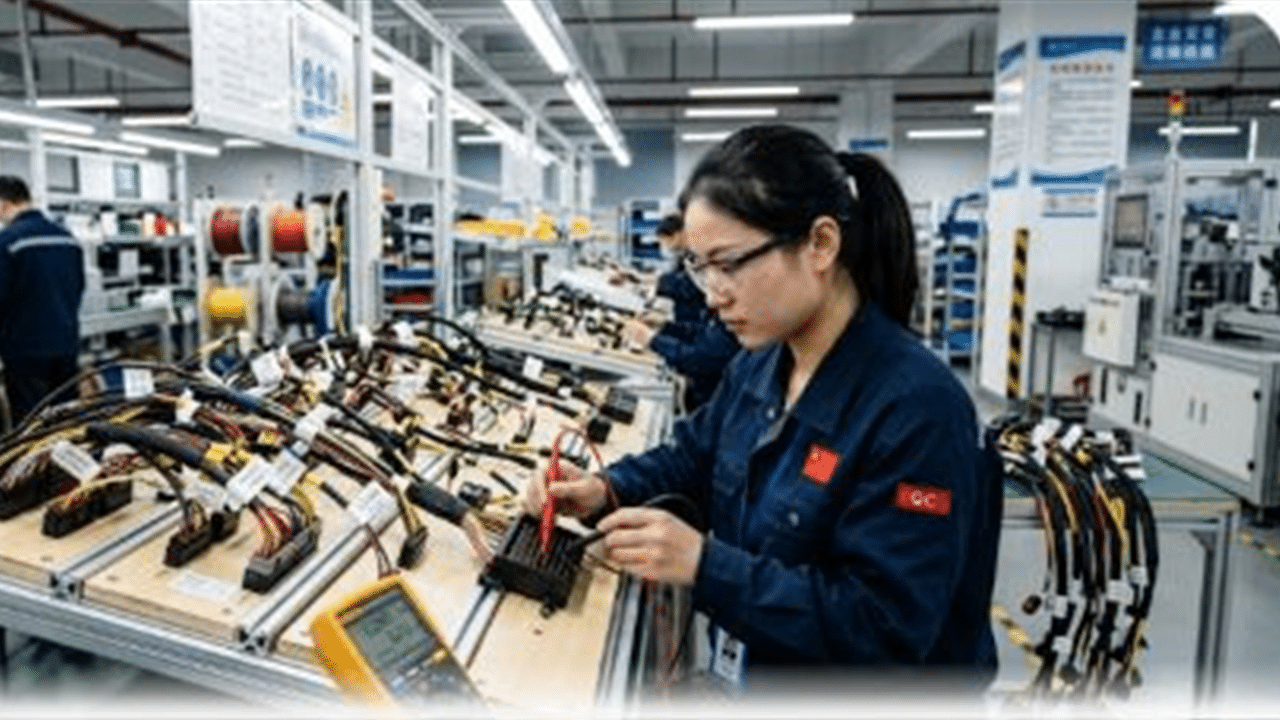
Small-Batch Manufacturing Video
See how customer-specific drawings and quantities are converted into controlled small-batch production, inspection and revision-managed repeat orders.
AI-assisted technical visualization for educational purposes. Actual components, tooling, lot sizes, manufacturing steps and acceptance criteria depend on the approved project requirements.
The workflow should convert customer inputs into an approved, inspectable assembly. Individual steps may vary by project, but each decision should remain traceable to agreed requirements.
| Buyer consideration | Low-volume project emphasis | High-volume program emphasis |
|---|---|---|
| Design status | May include evolving or highly project-specific requirements | Usually depends on a stable, fully released configuration |
| Order pattern | Smaller or irregular repeat quantities | Higher and more predictable demand |
| Engineering communication | Frequent clarification may be important | Changes are typically managed through a mature production process |
| Supplier evaluation | Focus on fit for complexity, review, control, and repeatability | Focus also includes sustained output and program-scale planning |
| Cost discussion | Should consider setup, components, inspection, and order pattern | Often places greater weight on scale and production efficiency |
These are general sourcing distinctions, not fixed rules. The appropriate approach depends on the assembly and approved project requirements.
Procurement and engineering teams should look beyond a general capability list. Ask how the supplier will review, document, build, inspect, and repeat the specific assembly.
Cablum provides custom manufacturing based on customer requirements, engineering support during project review, drawing and specification review, and prototype and production support.
Quality control is performed during manufacturing. Electrical testing and inspection are applied according to project requirements and customer specifications. Test reports may be provided according to customer requirements.
The exact manufacturing, inspection, documentation, and scheduling scope should be confirmed for each project. Cablum does not present a universal production quantity, testing plan, or delivery promise.
Send your available drawing, specifications, sample reference, expected quantities, and inspection requirements. Cablum can review the information and identify the technical items that need confirmation.