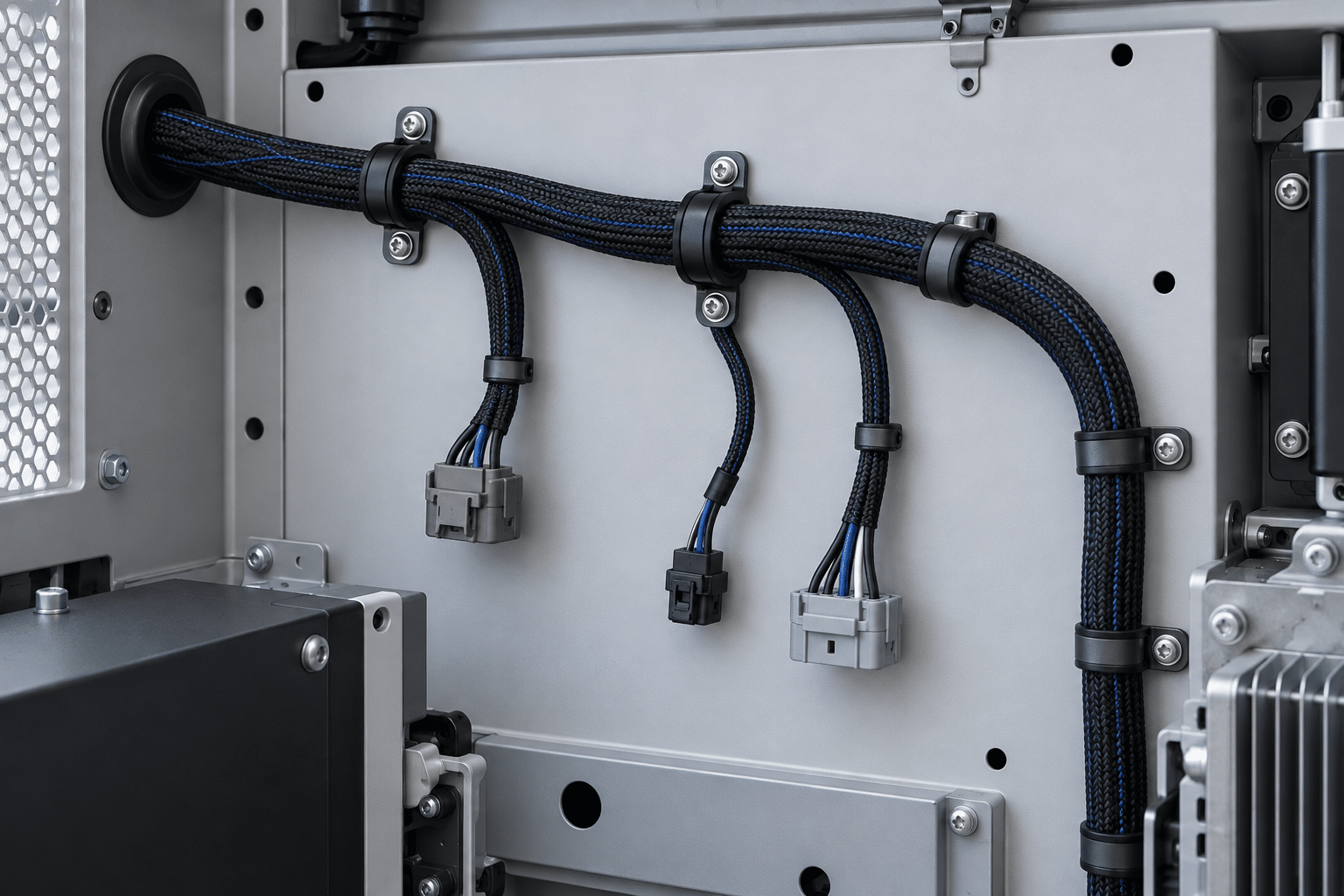
1. Main harness path
Show the intended route through the equipment and name the physical references used to locate the trunk.
OEM HARNESS LAYOUT GUIDE
Define how a wire harness should run through the equipment before a supplier reviews the drawing, BOM and assembly requirements.
Routing requirements connect the electrical design to the physical build. They help clarify branch locations, bend areas, connector orientation, protection points, label positions and inspection expectations without leaving the manufacturer to infer the intended path.
A quote-ready routing definition should show:
WHY ROUTING SHOULD BE CONTROLLED
A schematic can explain circuit intent, but it may not define how wires pass through a cabinet, vehicle, module or piece of equipment. If the drawing does not identify the intended path, the supplier may not know where branches leave the trunk, where the cable must clear a bracket, or which connector orientation controls assembly.
Routing requirements should be tied to customer-approved drawings and specifications. They should not depend on a generic supplier assumption about bend radius, protection material, label durability or inspection scope.
Use this page with the Wire Harness Drawing Checklist and Wire Harness Length and Dimension Requirements.
ROUTING INPUTS
Not every assembly requires the same routing detail. Include the information that controls fit, branch layout, assembly sequence, protection and inspection for the specific equipment.
Show the intended route through the equipment and name the physical references used to locate the trunk.
Identify where each branch leaves the main route and which feature defines the branch position.
Define the mating face, wire-entry side, latch direction and cable exit direction where orientation affects installation.
Mark sleeves, heat-shrink, wrapping, clamps or other project-specified protection points without assuming universal material performance.
Identify doors, panels, moving equipment or service loops that may affect routing review.
Locate labels or markers where position matters for installation, maintenance or inspection.
Show whether the harness is installed before or after surrounding parts when that affects connector reach or branch handling.
Mark routing assumptions, pending fit checks and released requirements clearly.
RFQ DECISION TABLE
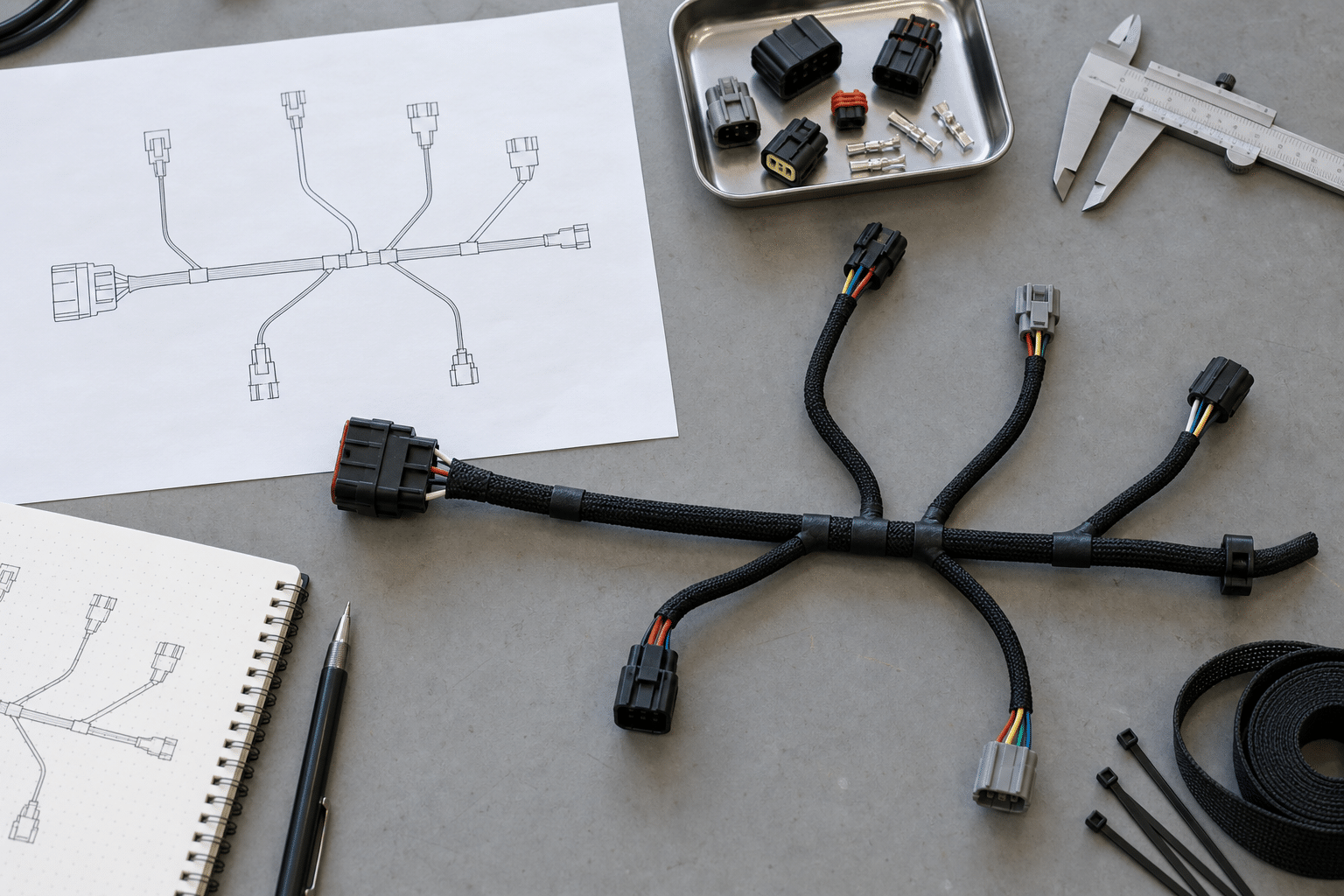
The goal is not to over-specify every bend. The goal is to make important routing decisions visible before quotation and prototype review.
| Ambiguous input | Question to resolve | Controlled treatment |
|---|---|---|
| Route shown only as a line | What physical references locate the harness? | Name the datum, route path and branch references |
| Branch drawn near a connector | Where does the branch actually exit? | Dimension the branch exit from a controlled point |
| Protection called out generally | Which area needs protection and why? | Mark start/end locations and customer-approved material requirements |
| Connector can rotate | Which orientation is approved for installation? | Show view direction, latch/key orientation and cable exit |
| Fit not yet confirmed | Is the route released or still pending? | Flag the open item before quotation assumptions become final |
CABLUM PROJECT REVIEW
Cablum is a Shenzhen-based custom wire harness and cable assembly manufacturer established in 2012, supporting customers in Europe and the United States.
Cablum can review customer drawings, specifications and customer-approved requirements during project review.
Customer-specified wire, connector, sleeve, label and protection information can be reviewed as project inputs.
Cablum provides prototype and production support based on project requirements, without implying a fixed quantity or schedule.
Inspection and electrical testing are defined according to customer-approved project requirements.
For related support, see Engineering & Prototyping, Products, and Quality Testing.
BUYER QUESTIONS
PREPARE THE RFQ
Send the drawing, BOM, connector information, routing notes, quantity context and inspection requirements for project-specific review.