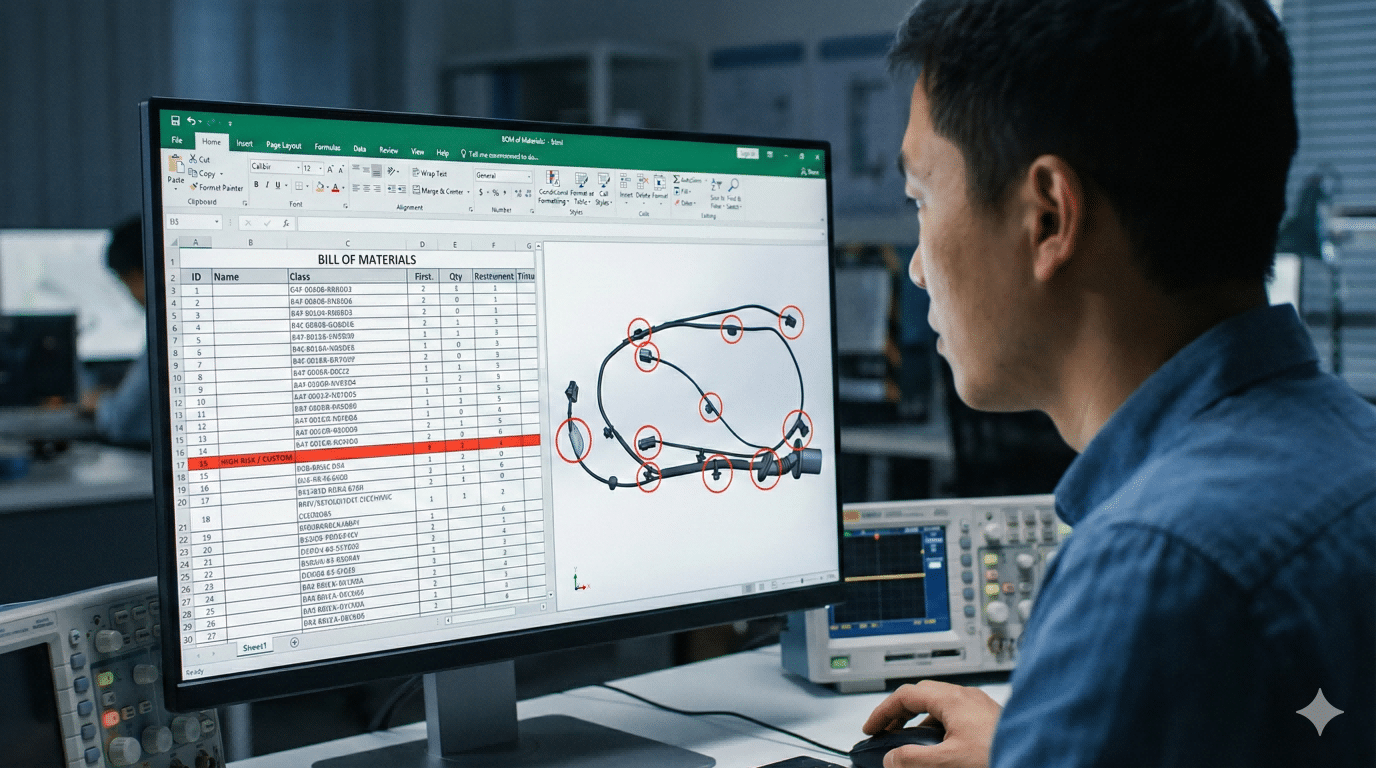
For decades, the wire harness has mainly served as a reliable path for power and signal transmission. But as electric vehicles, industrial automation, robotics, medical devices, and connected equipment become more advanced, OEM engineers are asking more from cable assemblies.
Today, a smart wire harness may include embedded sensors, diagnostic functions, shielded data transmission, small PCB assemblies, overmolded protection, and application-specific testing. Instead of only connecting point A to point B, the harness can support monitoring, feedback, and system-level reliability.
This article explains what smart wire harnesses are, which technologies make them possible, where they are used, and what OEM teams should consider before designing a sensor-integrated or PCBA-integrated cable assembly.
1. What Is a Smart Wire Harness?
A smart wire harness is a cable or wiring assembly that goes beyond passive power or signal transmission. It may integrate sensors, electronic components, diagnostic circuits, shielding, protection features, or small PCB assemblies to support monitoring and communication within a larger system.
For example, instead of only carrying power, a smart cable assembly may help monitor temperature, current, voltage, vibration, humidity, or connection status. In some applications, this information can support predictive maintenance, fault detection, system diagnostics, and safer operation.
Not every application needs a fully intelligent harness. In many OEM projects, the practical goal is more focused: integrating one sensor, adding a small PCBA, improving signal integrity, protecting a sensitive connection, or creating a cable assembly that can be tested and traced more reliably.
Engineering Tip
If your cable assembly needs sensing, diagnostics, shielding, or embedded electronics, request a DFM review before finalizing the connector, cable, overmold, and test requirements. Early review can help reduce redesign, tooling cost, and production risk.
2. Key Technologies Behind Smart Wire Harnesses
Smart wire harness design depends on several technologies working together. The exact structure depends on the application, environment, signal type, test requirements, and production volume.
Embedded Sensors
Temperature, humidity, current, voltage, vibration, or strain sensors can be integrated near critical points of the cable assembly to support monitoring and maintenance.
Sensor-integrated cable assemblies are useful when the operating environment affects reliability. Examples include high-flex robotic cables, battery systems, industrial equipment, and compact electronic devices where temperature or current feedback may be important.
The challenge is not only placing the sensor, but also protecting it from mechanical stress, moisture, EMI, vibration, and assembly variation.
PCBA Integration
Small PCB assemblies can be integrated into cable assemblies for signal conditioning, LED indication, interface conversion, current sensing, or simple diagnostic functions.
A PCBA-integrated cable assembly requires close coordination between electronics design, wire harness manufacturing, enclosure design, overmolding, sealing, and final testing.
In many cases, the PCBA is protected inside a molded or enclosed area to improve strain relief, insulation, and environmental resistance.
Shielded Signal and Data Cables
Smart systems often require reliable signal transmission. Shielding, twisted pairs, controlled routing, grounding, and connector selection can help reduce EMI and signal noise.
For applications involving CAN, LIN, Ethernet, sensor signals, or other communication lines, the cable design must consider signal integrity, bend radius, shielding termination, and compatibility with the final device architecture.
This is where early engineering review is valuable. Small layout or connector decisions can affect performance, assembly efficiency, and testing complexity.
Overmolding and Protection
Overmolding can protect sensitive joints, PCBA areas, sensor locations, and strain relief zones while improving durability and appearance.
For smart cable assemblies, overmolding is often more than cosmetic. It may protect electronics, help seal the assembly, reduce strain, and improve resistance to handling, vibration, and moisture.
However, overmolding also introduces design questions: material selection, mold cost, thermal stress, sensor positioning, connector compatibility, and inspection method.
Planning a Sensor-Integrated or PCBA-Integrated Cable Assembly?
Send us your concept, BOM, drawing, or sample photos. Cablum’s engineering team can review manufacturability, connector selection, overmolding, and testing requirements.
3. Where Smart Wire Harnesses Are Used
Smart wire harnesses and embedded cable assemblies are especially valuable in applications where systems require monitoring, reliability, compact design, signal integrity, or predictive maintenance.
EV & Automotive Electronics
Modern vehicles use more sensors, power distribution, data communication, and safety-related electronics. Smart harness concepts can support battery systems, ADAS modules, lighting, charging interfaces, and diagnostic connections.
Industrial Automation & Robotics
Robots and automated equipment often need high-flex cables, sensor feedback, cycle monitoring, and reliable signal transmission in moving or harsh environments.
Medical & Diagnostic Equipment
Diagnostic devices and medical equipment may require compact cable assemblies, signal stability, traceability, clean assembly practices, and carefully documented inspection requirements.
Energy Storage & Battery Systems
Battery and energy storage systems may use sensing, voltage monitoring, current feedback, temperature detection, and robust connector systems for safety and maintenance support.
4. Design Considerations for Smart Cable Assemblies
Smart cable assemblies introduce more design variables than traditional wiring. Engineers should evaluate the mechanical, electrical, environmental, sourcing, and testing requirements together before releasing a design.
| Design Area | Key Questions | Why It Matters |
|---|---|---|
| Sensor Location | Where should the sensor be placed for accurate measurement? | Placement affects data accuracy, protection, and assembly consistency. |
| PCBA Protection | Will the electronics require enclosure, potting, or overmolding? | Protects electronics from stress, vibration, moisture, and handling damage. |
| EMI Shielding | Does the application require shielding or twisted pairs? | Helps maintain signal stability in noisy environments. |
| Strain Relief | How will bending, pulling, or repeated movement be controlled? | Improves cable life and reduces failure at transition points. |
| Connector Selection | Are connectors available, reliable, and suitable for the environment? | Affects sourcing, sealing, mating cycles, cost, and lead time. |
| Testing Plan | What electrical, functional, and visual tests are required? | Ensures the complete assembly works before shipment. |
| Manufacturability | Can the assembly be built repeatedly at the target quantity? | Reduces redesign, scrap, and production delays. |
If your design includes sensors, electronics, shielding, or overmolding, it is best to review the full assembly early instead of treating each part separately. Cable, connector, PCB, molding, and test requirements all influence one another.
Related Reading
Before adding sensors or electronics to a cable assembly, it is important to control cost and manufacturability. Read our Wire Harness DFM Case Study to see how early design review can reduce tooling cost and lead time.
5. How Cablum Supports Smart Cable Assembly Projects
Smart wire harness projects require more than wire cutting and crimping. They require careful review of BOM, connectors, wire selection, shielding, overmolding, assembly method, inspection points, and final testing.
Cablum supports OEM customers with custom wire harness and cable assembly manufacturing, including engineering review, prototyping, component sourcing, assembly process planning, overmolded cable assemblies, and quality-controlled production.
Engineering & DFM Review
Review drawings, BOM, connector selection, tolerance, shielding, strain relief, and manufacturability before production.
Prototype Support
Build early samples for design verification, functional checking, and assembly review before mass production.
Overmolded Cable Assembly
Support molded strain relief, connector protection, sealing, and custom cable assembly appearance.
Electrical & Functional Testing
Support continuity testing, miswire testing, visual inspection, and customer-specific test requirements.
Whether your project involves a traditional wire harness, a sensor cable assembly, or a PCBA-integrated cable assembly, early supplier involvement can help reduce design risk and improve production readiness.
Planning a Smart Wire Harness or Embedded Cable Assembly?
Send us your drawing, BOM, connector list, sensor requirement, or sample photos. Cablum can help review manufacturability, sourcing, overmolding, and testing requirements.