1. Product identity
State the part number, assembly description, drawing number, and governing revision. Identify any family-level requirement that applies to more than one part.
DEFINE ACCEPTANCE BEFORE QUOTATION
A wire harness test specification tells the supplier what must be checked, how acceptance is decided, which records are required, and which revision controls the work.
Use this framework to separate product requirements from test methods and to keep quotation, manufacturing, inspection, and approval aligned.

It is a controlled project document, drawing section, or referenced requirement that defines applicable inspections and electrical checks, acceptance criteria, coverage or sampling, required records, and the governing revision for a wire harness or cable assembly.
WHY IT MATTERS
Writing “electrical test required” leaves important questions open. The supplier still needs to know the approved connection definition, the applicable product or process stage, the required coverage, the acceptance result, and whether a record must accompany the shipment.
A useful specification links each requirement to a controlled input. That input may be a drawing, connection table, customer specification, approved sample reference where applicable, or another customer-approved document.
Cablum applies quality control during manufacturing. Inspection and electrical testing are defined according to customer specifications and project requirements, so the RFQ should make the expected scope clear rather than assume one universal test plan.
EIGHT CONTROLLED INPUTS
Keep the requirement, acceptance rule, coverage, record, and revision connected.
State the part number, assembly description, drawing number, and governing revision. Identify any family-level requirement that applies to more than one part.
Reference the approved circuit, pinout, cavity map, or connection table that an electrical requirement must follow.
Name the feature to be checked, such as identification, routing, protection, connector condition, or another drawing-defined characteristic.
Define the required electrical or inspection scope without assuming that every method applies to every assembly.
State the customer-approved limit, condition, comparison basis, or pass/fail rule. Avoid relying on an undefined phrase such as “standard quality.”
Identify whether the requirement applies by unit, lot, process stage, or an approved sampling instruction. Do not leave coverage implicit.
Define whether a result, summary, lot record, or other agreed evidence is required and when it must be supplied.
Identify who approves revisions and how changed criteria, methods, or records are communicated before the next build.
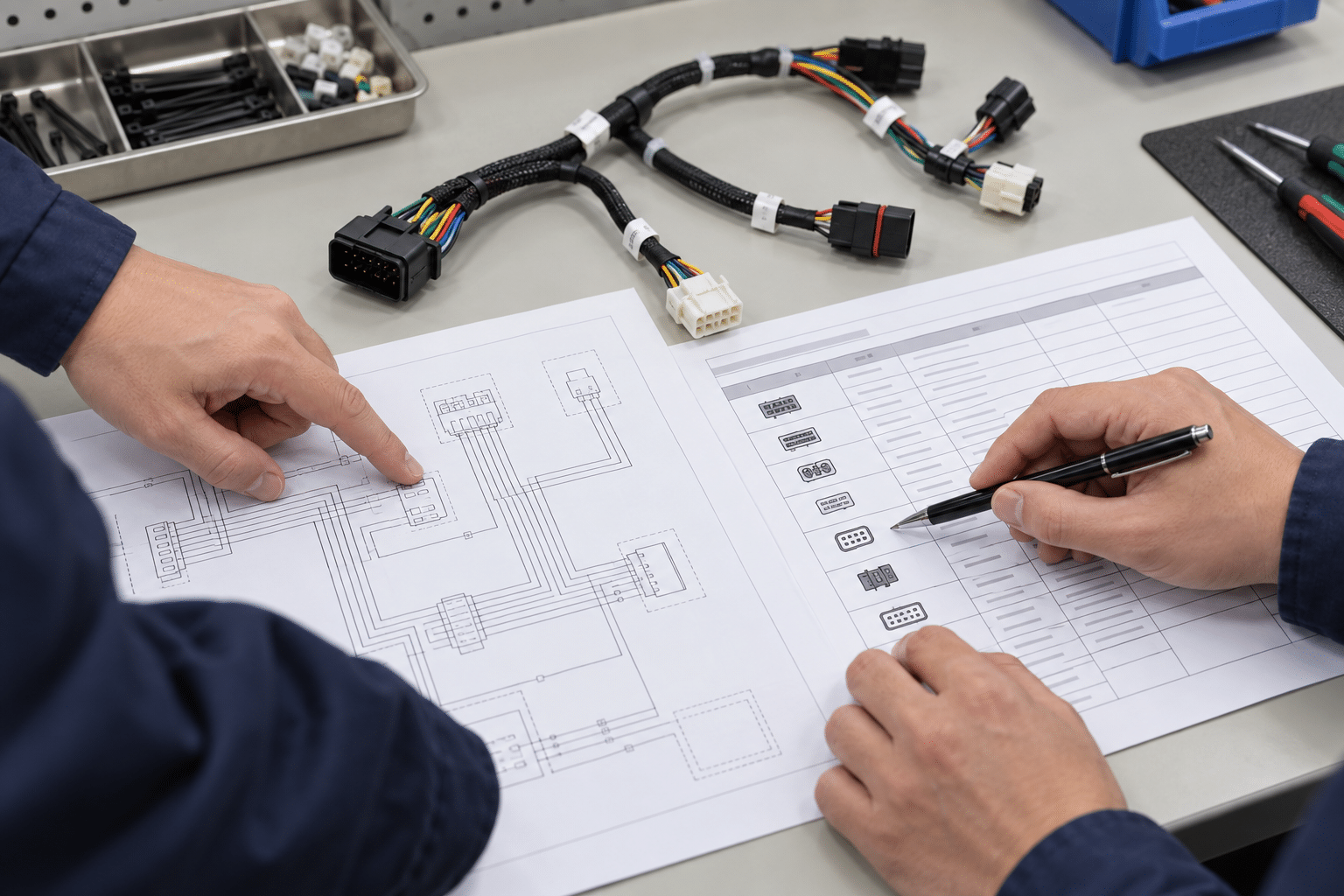
SCOPE SEPARATION
A customer requirement defines what the assembly must meet. A supplier capability review determines whether the requested method, equipment, coverage, and documentation can be supported for that project. These are related decisions, but they are not interchangeable.
Defines the required outcome for the part, including the approved drawing or specification basis.
Defines checks used during manufacturing where the customer requires them.
Defines the evidence needed before a lot or shipment is accepted.
RFQ REVIEW TABLE
| Ambiguous instruction | Information to add | Buyer decision supported |
|---|---|---|
| “Test the harness.” | Applicable characteristic, method or functional intent, acceptance basis, and coverage | Whether the supplier can quote the requested scope |
| “Check the pinout.” | Approved connection table, connector view, cavity references, revision, and expected result | Which controlled circuit definition governs |
| “Inspect workmanship.” | Drawing-defined features or customer-approved workmanship criteria | How acceptance is decided without an undefined standard |
| “Provide reports.” | Required record type, content, frequency, format, and delivery point | Whether documentation is part of the quoted scope |
| “Use the latest revision.” | Exact document number, revision identifier, approval date, and change owner | How obsolete requirements are prevented from controlling the build |
RECORD PLANNING
Test and inspection records can be provided according to customer requirements where applicable. Their availability, contents, and scope should be agreed for the project rather than assumed.
Before requesting a record, define who uses it and what decision it supports. A buyer may need confirmation of a completed check, while an engineer may need a result tied to a specific part and revision. A quality team may need lot identification or an exception record. These needs can produce different documentation requirements.
SUPPLIER REVIEW
Confirm that the drawing, BOM, connection definition, and test requirement refer to compatible revisions.
Confirm which products, lots, or process stages each requirement covers.
Replace subjective language with a customer-approved acceptance basis that can be reviewed.
Confirm availability, content, and timing before treating records as part of the supply scope.
Use Cablum’s wire harness drawing checklist, BOM requirements, and connector selection requirements to align the test specification with the rest of the RFQ package.
CABLUM PROJECT REVIEW
Cablum is a Shenzhen-based custom wire harness and cable assembly manufacturer established in 2012.
Cablum can review customer drawings, specifications, BOM information, and customer-approved requirements during project evaluation. Prototype and production support is based on project requirements.
Inspection can be performed according to customer specifications and project requirements. Electrical testing is also defined according to project requirements. Specific methods, limits, coverage, equipment, and report contents should be confirmed for the applicable assembly.
Review related quality testing capabilities, engineering and prototyping support, and custom wire harness and cable assembly products.
BUYER QUESTIONS
DEFINE THE ACCEPTANCE SCOPE
Share the part number, revision, connection definition, acceptance criteria, coverage, record needs, quantities, and other customer-approved requirements.